“We get to go through life with our clients. I feel privileged to meet with them and hear about what is happening in their world and with their families. They share their dreams and fears with us, and we get to help them achieve those dreams and conquer those fears.”
Scott infuses everything in his life with care, dedication and a commitment to helping others. As a financial advisor, he serves his clients with wisdom, integrity and kindness, and he has a knack for making complex things simple. He is proud to lead a team of wonderful people and to have helped shape MarsJewett’s culture of service.
A Bellevue native, Scott graduated with honors from Pacific Christian College with dual degrees in Business Administration and Biblical Studies. After college, he spent the first seven years of his career at Boeing. During that time, he and his wife began helping members of their church who were struggling to manage their finances or facing financial crisis, and this helped spark his passion to become a financial advisor. In 1994, he attended a seminar Glenn (Mars) was teaching for the Boeing Management Association, and a year later, Glenn hired him. The rest, as they say, is history.
Scott feels that he truly found his calling as a financial advisor, as it combines his passion for helping people with his love of untangling the technical complexities of finance and investing. He actually gets excited when Congress changes the tax and finance laws, because it means he gets to dig into the research and figure out new planning strategies that will benefit our clients!
Scott is a devoted husband and father of three. Sports are a lifelong passion for him and his wife Kim, and when they’re not watching their own kids play, you’ll likely find them rooting for the Mariners, Seahawks or Huskies—he even proposed to Kim on the 50-yard line of Husky Stadium. Now that his kids are (mostly) out of the house, he has more time to work on his golf game… and he’s quick to say that it needs some work.
Scott is also very active in his community and his church, where he has served for over 25 years in financial ministry. He previously served on the boards of two non-profit organizations, and currently serves on the trust and investment committee at the school his kids graduated from.
Key takeaways from our conversation with Dimensional’s Marlena Lee, PhD
A few weeks ago, we had the pleasure of hosting Marlena Lee, PhD, Global Head of Investment Solutions at Dimensional Fund Advisors, for a conversation about what’s driving markets right now and how disciplined investors can think about it all. For those of you who couldn’t join us in person, here are the highlights.
The short version? Markets have been eventful, the headlines have been loud, and the case for staying diversified and disciplined is as strong as ever. Here’s what stood out.
Volatility Is the Price of Admission
Marlena opened by reminding us just how quickly markets can move. Anyone who got spooked and sold early in the year would have missed a sharp rebound over the following weeks. That’s the trouble with timing the market: you have to be right twice, and the strongest days often cluster right after the scariest ones.
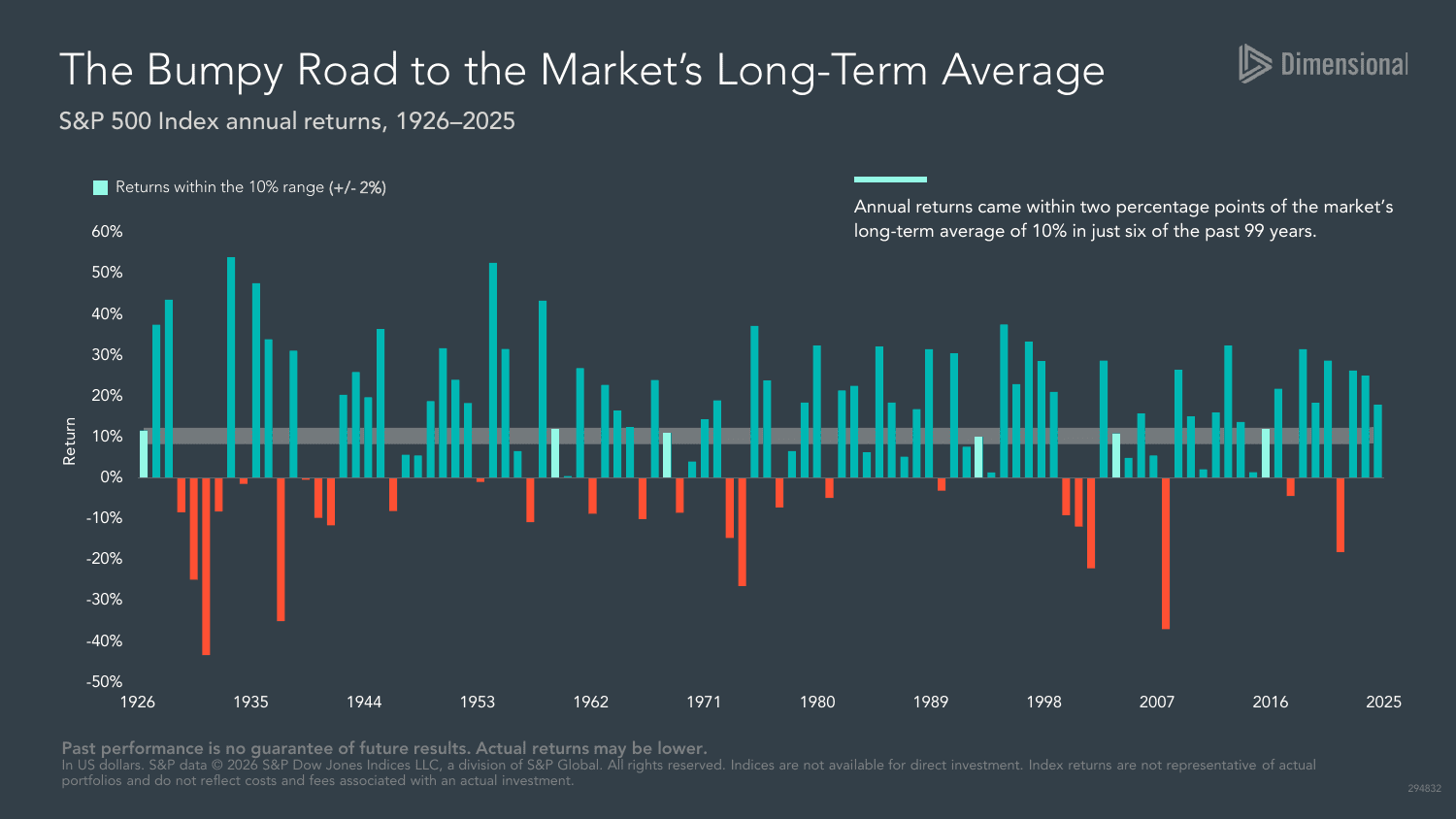
Her bigger point was that volatility isn’t a malfunction—it’s the feature that makes long-term returns possible. The swings are the risk you’re compensated for. Drawing on roughly 100 years of data, she noted that equities have historically returned around 10% a year for investors willing to ride out the bumps. And those bumps are the norm: in only six of the past 99 years did annual returns actually land within two points of that 10% average.
The bumpy road to the average. S&P 500 annual returns, 1926–2025. The “average” 10% year is almost never an average-looking year.
The Market Is Looking Ahead, Not at Today’s Headlines
One of the most useful reframes of the evening: prices are forward-looking. By the time bad news dominates the headlines, the market has usually already priced in much of it. That’s why markets can rally precisely when the outlook feels grimmest—any outcome less terrible than feared can push them higher. She walked through the early COVID-19 crash as a vivid example: selling into the panic of early 2020 would have locked in losses right before one of the fastest recoveries on record.
Watch the Concentration
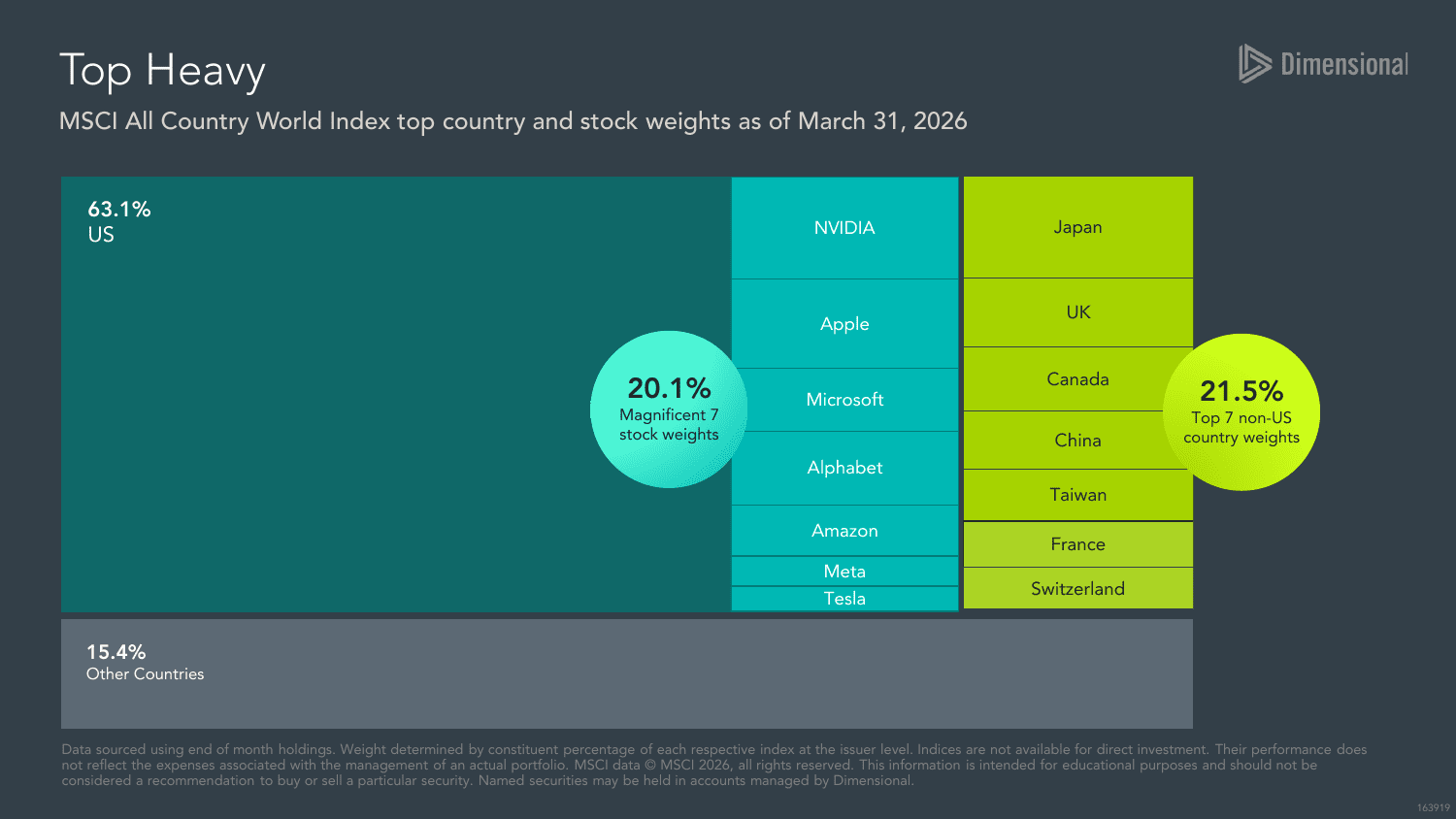
Marlena spent real time on the “Magnificent 7”—Alphabet, Amazon, Nvidia, Apple, Meta, Tesla, and Microsoft. There’s no question they’ve powered a huge share of recent gains, but that dominance cuts both ways. The 20 largest companies in the S&P 500 now account for nearly half the index’s value, so plenty of investors who feel well-diversified are quietly very overweight a handful of large U.S. tech names.
There’s a valuation wrinkle, too: those seven names occupy about 20% of a global allocation but contribute only around 13% of its earnings—a sign you’re paying a premium relative to the profits underneath.
Top heavy. The Magnificent 7 alone make up about 20% of global equity market value—a remarkably concentrated slice for a “diversified” portfolio.
The Case for Going Global
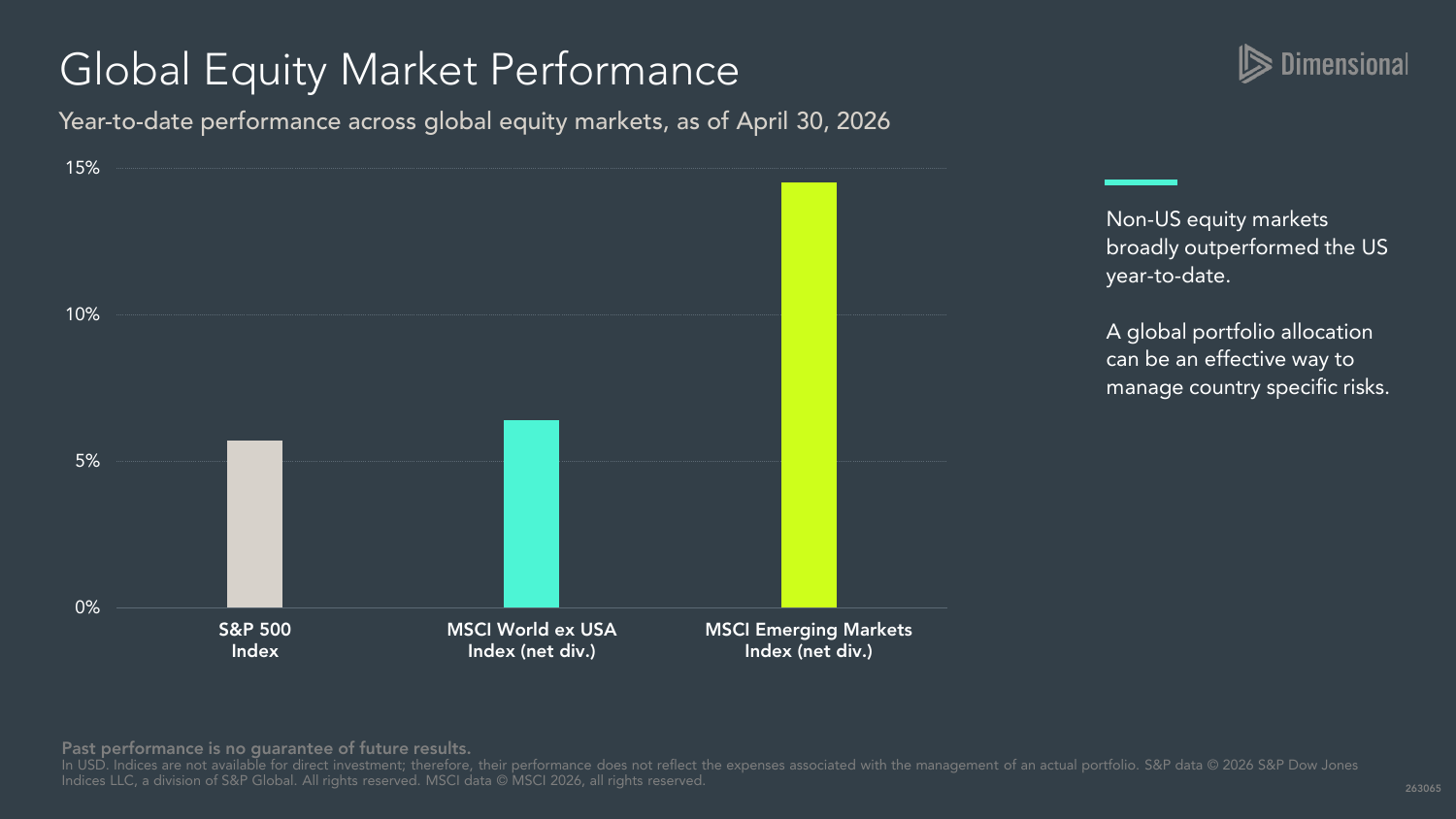
If concentration is the risk, diversification is the antidote. Nobody can reliably predict which region will lead next—so the smarter move is to hold them all. That point was well-timed: non-U.S. markets broadly outperformed the U.S. early in the year, with emerging markets up around 20% at one stage versus roughly 9% for the S&P 500.
Leadership rotates. Year-to-date through April 30, 2026, non-US developed and emerging markets outpaced the S&P 500—a reminder that the next leader is hard to call in advance.
Going beyond the S&P 500 into a globally diversified portfolio can mean holding more than 13,000 stocks, which dramatically reduces the chance that any single company or sector dictates your results.
On AI: Enthusiasm Without the Overreach
Marlena was measured on AI. Yes, it may bring real productivity gains, and yes, it’s lifted plenty of well-known tech names. But she was skeptical of chasing it through narrow thematic funds—many AI-focused ETFs haven’t actually beaten the broader tech sector or a diversified benchmark, and picking the individual winners and losers is a perilous game.
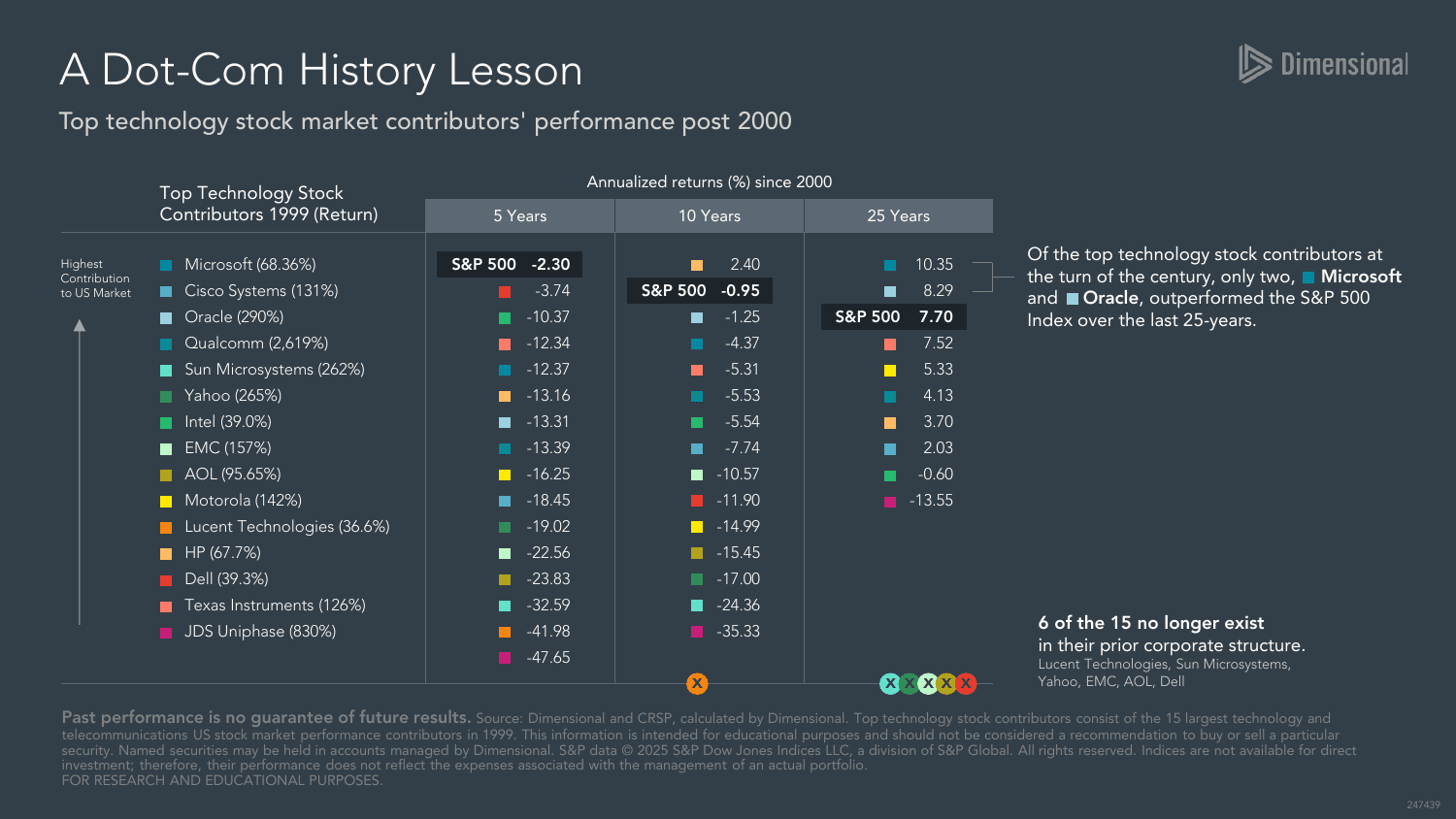
The dot-com era offers a sobering lesson here. The internet genuinely transformed the world, yet most of the top “internet” stocks of 1999 either underperformed for decades or disappeared entirely.
A dot-com history lesson. Of the 15 largest tech contributors at the turn of the century, only two beat the S&P 500 over the next 25 years—and six no longer exist in their prior form.
The reassuring flip side: if a technology truly permeates the economy, broadly diversified investors tend to capture its gains automatically. The big AI players are already core holdings in any standard global allocation—you don’t need a concentrated bet to participate.
A Few Things on the Horizon
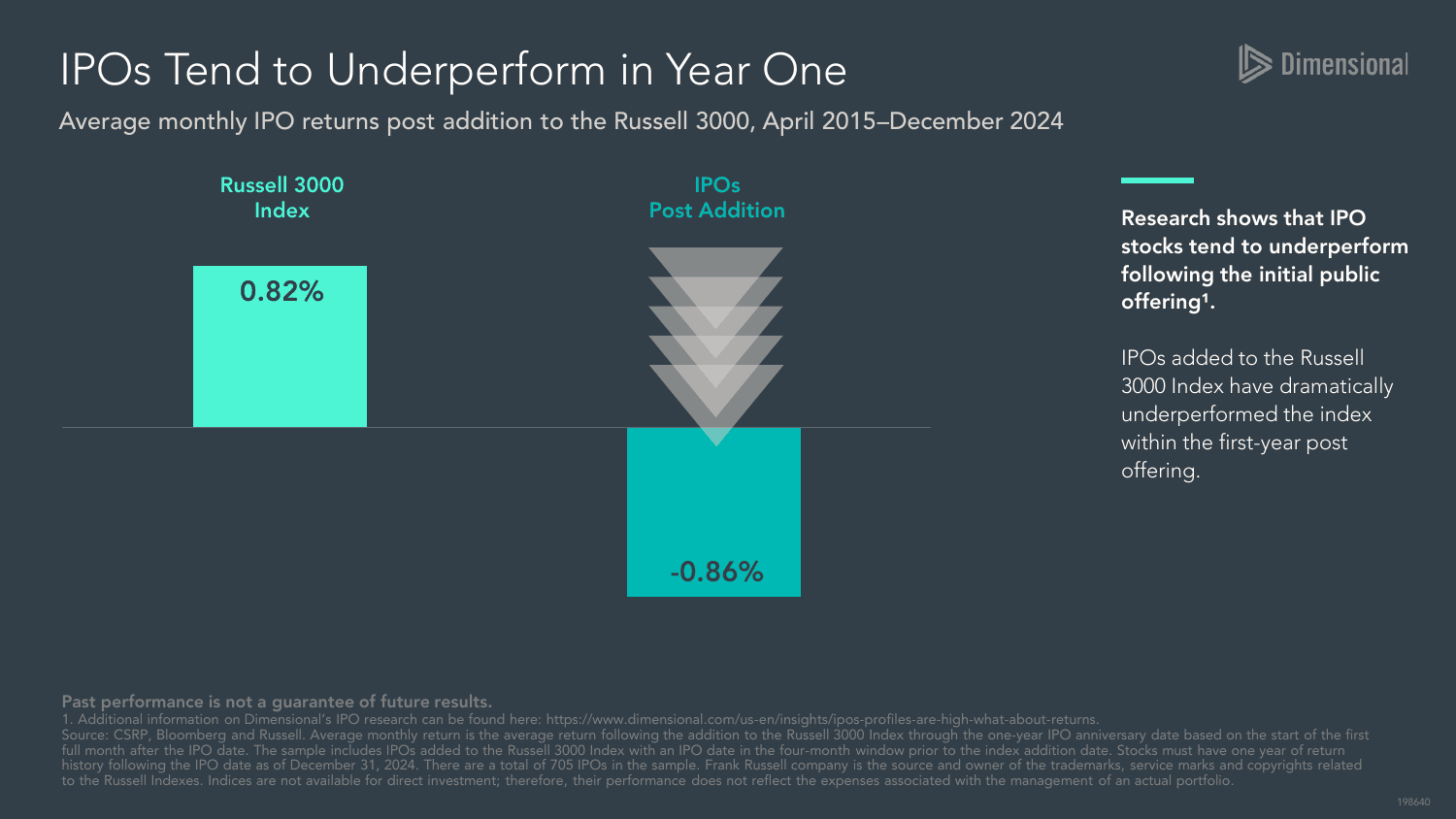
IPOs. With some large offerings potentially coming—SpaceX among the most talked-about—Marlena offered a word of caution. In a typical IPO, only 3% to 5% of shares hit the public market at first; as insiders sell larger stakes over time, that growing supply can weigh on the price.
Buyer beware at the offering. IPOs added to the Russell 3000 have, on average, underperformed the index in their first year on the market.
Inflation and stagflation. Inflation has been creeping up, and recession talk has grown. Marlena’s reminder: stocks can still post positive returns even when recession headlines arrive, because prices already reflect expectations. A balanced, patient portfolio has weathered a wide range of macroeconomic conditions.
The Bottom Line
Marlena closed where she began—on discipline. Yes, the long-term equity return has hovered around 10%, but earning it means accepting that any given year can look nothing like that average. 2020 was the perfect illustration: a brutal start, followed by a recovery that rewarded everyone who stayed put.
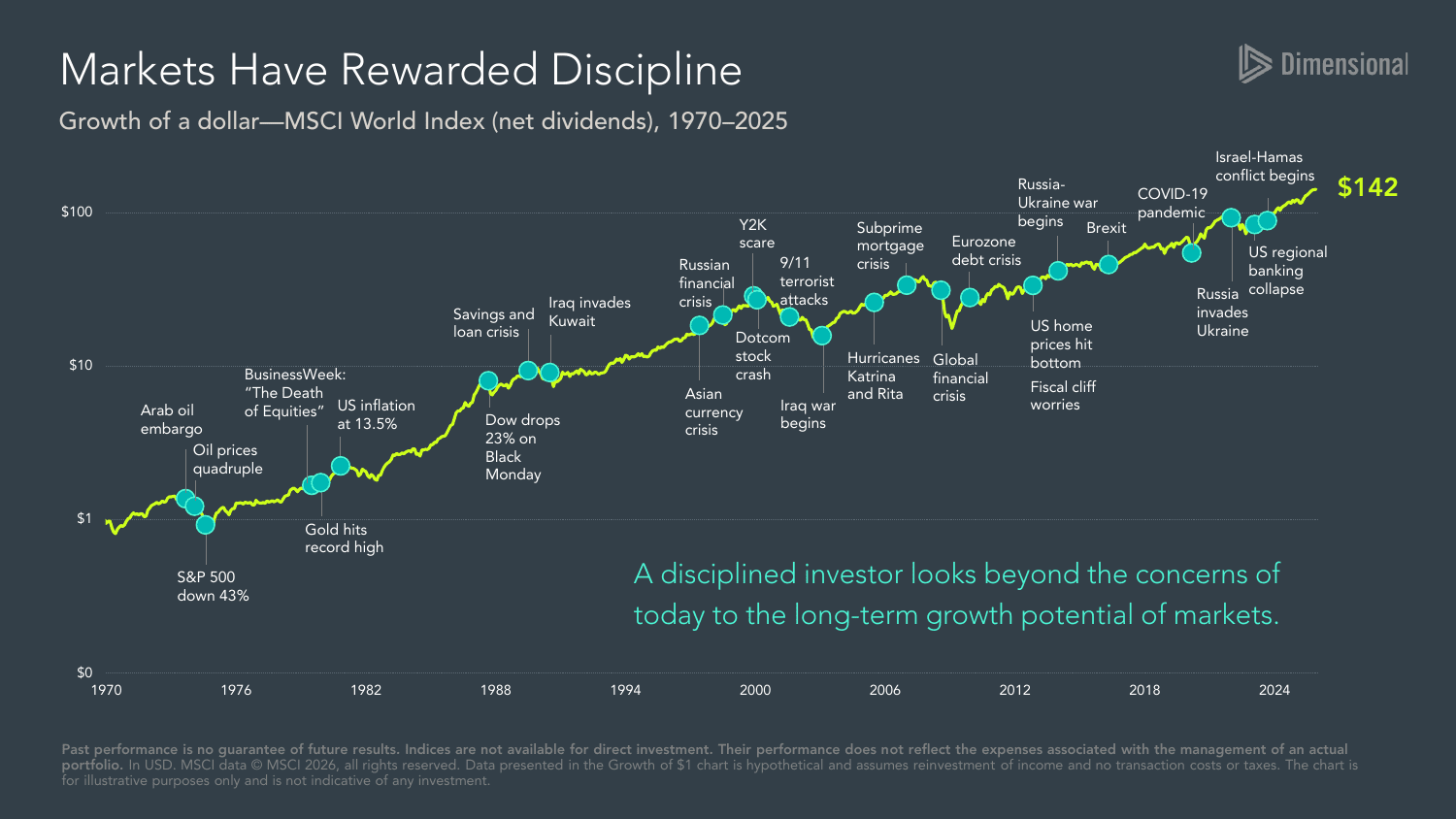
Markets have rewarded discipline. Growth of $1 in the MSCI World Index since 1970, through every crisis along the way. The headlines fade; the long-term trend has endured.
A disciplined investor looks beyond the concerns of today to the long-term growth potential of markets.
Her parting advice for navigating the noise was refreshingly simple:
Stay diversified, across companies, sectors, and especially regions.
Stay disciplined when the headlines get sensational.
Work with advisors who put your interests first.
Have a question about your own portfolio?
That last point is where we come in. If anything here raised a question about your allocation or how these themes apply to your situation, we’d love to talk it through. Reach out anytime.
This material is provided by MarsJewett Financial Group for educational and informational purposes only. It should not be construed as individualized investment, legal, tax, or financial planning advice, or as a recommendation to buy, sell, or hold any security, investment strategy, or investment product. Any examples discussed are general in nature and may not be appropriate for every investor. Please consult your financial professional regarding your individual circumstances before making investment decisions.
This recap summarizes certain views and information shared by Marlena Lee, PhD, of Dimensional Fund Advisors at a MarsJewett client event. Dimensional Fund Advisors is not affiliated with MarsJewett Financial Group. MarsJewett may recommend or allocate client assets to Dimensional mutual funds or ETFs when appropriate based on a client’s investment objectives, risk tolerance, time horizon, and other relevant circumstances. Clients invested in such funds bear the funds’ fees and expenses, in addition to any applicable advisory fees. MarsJewett does not receive compensation from Dimensional Fund Advisors for recommending Dimensional funds.
The opinions and information discussed reflect the views presented at the event and are subject to change without notice. Market and economic information is based on sources believed to be reliable, but accuracy and completeness are not guaranteed. Past performance is not indicative of future results. All investing involves risk, including the possible loss of principal. Diversification and asset allocation do not guarantee a profit or protect against loss in declining markets.
Any index returns, market data, charts, or historical examples are provided for illustrative purposes only. Indexes are unmanaged and cannot be invested in directly. Index performance does not reflect advisory fees, transaction costs, taxes, or other expenses that would reduce actual investor returns. References to historical averages, hypothetical compounding, or long-term market returns are not projections, guarantees, or indications of future performance.
To the extent this material discusses specific companies, sectors, funds, indexes, or investment themes, such discussion is for educational purposes only and should not be interpreted as a recommendation or endorsement of any particular security, product, or strategy. Individual client portfolios may differ materially from the examples discussed.
Client Education · Estate Planning Washington State’s estate tax changed again this July—and most families with meaningful assets have more to gain from reviewing their plan now than they realize. Washington...
Client Education · Planning & Tax For the first time, families can begin building Roth wealth for a child from a very young age—and the numbers are striking. Until now, there was no good way to start saving for a child’s retirement. Roth and...
If you are interested in the new numbers affecting 2026 taxes, retirement contributions, health savings, Medicare, and more, please read or download the PDF below to have on hand. As always, do not hesitate to reach out to our team with any questions. Key Financial...
Client Education · Estate Planning Washington State’s estate tax changed again this July—and most families with meaningful assets have more to gain from reviewing their plan now than they realize. Washington...
Client Education · Planning & Tax For the first time, families can begin building Roth wealth for a child from a very young age—and the numbers are striking. Until now, there was no good way to start saving for a child’s retirement. Roth and...